Agentic AI for Mission-Driven Organizations: What Works, What Doesn't
I was running orphanages on three continents before most people had heard of the internet. In 1995, I built adoption.com, one of the earliest social-impact platforms on the web, back when "going online" meant listening to a modem shriek for thirty seconds. The organizations I worked alongside had missions that couldn't afford failure: children's welfare, family preservation, emergency response. When a system broke down, people got hurt. That clarity has stayed with me across thirty years of building technology for organizations that operate at the edge of their capacity.
So when I watch the AI hype cycle roll into the nonprofit sector, I feel a particular kind of anxiety. Not because AI can't help. It can, and it does. But because the failure modes for mission-driven organizations are different from the failure modes in commercial tech, and most of the guidance coming out right now is written by and for commercial operators.
This article is for executive directors, program managers, board members, and faith community leaders who are sitting across the table from a vendor right now, or trying to figure out if AI belongs in their budget request for next year. I'm going to tell you what I've seen work, what I've seen blow up, and the specific questions you need to be asking before you spend a dollar.

Why the Mission-Driven Sector Is Different
Let me name the structural realities that make AI implementation in this sector genuinely harder than in a for-profit company.
Volunteer turnover creates a training treadmill. Nonprofit staff turnover runs around 20% annually, and that figure doesn't capture the churn in volunteer roles that many organizations depend on for day-to-day operations.[1] Every time someone leaves, you're not just losing institutional knowledge, you're losing whatever competency they built around your tools. An AI system that requires consistent, skilled operation becomes a liability when your "operator" is a rotating cast of part-time staff and well-meaning volunteers who have three hours a week to give you.
Restricted funding isn't just an inconvenience, it's a structural wall. Nearly 90% of foundations provide no AI implementation support, and fewer than 15% plan to increase this in the next three years.[2] When your budget is grant-funded and grant-restricted, investing in AI infrastructure means finding unrestricted dollars in an environment where unrestricted dollars are already the scarcest resource you have. Larger nonprofits with annual budgets over $1 million are adopting AI at nearly twice the rate of smaller organizations (66% vs. 34%), which tells you exactly who this funding gap is hurting.[3]
The ethical weight is heavier. When an e-commerce site shows someone the wrong product recommendation, nothing terrible happens. When an AI tool makes a bad decision in a child welfare context, a housing placement, or a refugee service delivery workflow, the consequences land on people who are already vulnerable. That's not a reason to avoid AI. It's a reason to implement it carefully and explicitly, with human oversight baked in, not bolted on afterward.
Most organizations don't have a strategy, and that's the real problem. While 92% of nonprofits are now using AI tools in some capacity, only 7% report major improvements in organizational capability.[4] Eighty-five percent are exploring AI tools, but only 24% have a formal strategy, and 76% have no AI policy at all.[3] That gap between exploration and strategy is where most AI investments go to die.
What Actually Works
I want to be specific here, because "AI can help with communications and operations" is not useful advice. Let me tell you the actual use cases where I've seen mission-driven organizations get real returns.
Document Processing and Knowledge Management
This is, without question, the highest-return use case I've seen in mission-driven contexts. Organizations accumulate enormous volumes of documents: grant reports, program notes, beneficiary records, policy documents, donor correspondence, meeting minutes, compliance filings. This content is full of institutional knowledge that nobody can find because it lives in someone's inbox or a shared drive with 6,000 untitled files.
AI-powered document processing and retrieval, including internal knowledge management tools built on your own data, is where you get results without requiring high levels of ongoing technical skill to operate. Bridgespan found that some organizations have quadrupled their annual translation capacity through AI tools, and reduced end-user response times by more than 75%.[2] Both of those are document and communication wins.
The reason this works is structural. Once you set up a document processing system, it doesn't require daily expert intervention. It runs. Your rotating staff can query it with natural language. You're not depending on someone to maintain a complex technical workflow every Tuesday morning.
Donor Communication and Fundraising Outreach
This is where the data is most compelling. Organizations using AI for fundraising have seen 20-30% increases in donations through personalized outreach and better engagement strategies.[4] AI automation saves organizations 15-20 hours weekly on administrative tasks, and a significant portion of those hours are in donor communication workflows.[5]
Nearly 25% of nonprofits now use AI to streamline grant writing, and 60% of nonprofit professionals say grant writing is the number one use case they want to try.[3] The results I've seen track with the data: AI drafting tools help small teams produce more grant applications without burning out the one person in the organization who knows how to write a funding narrative.
But I want to be honest about the limitation here. AI can draft, but it can't discern. It doesn't know that a particular foundation program officer hates jargon, or that your relationship with a major donor is fragile right now and requires a more careful touch. The organizations getting the most out of AI donor tools are using them to eliminate the mechanical work (formatting, boilerplate, first drafts) so that human attention can go to the relationship decisions that actually determine whether someone gives.
Program Tracking and Impact Measurement
If you're tracking beneficiaries across a case management system, AI can help you spot patterns your staff would never catch manually. Which program cohorts show the strongest outcomes? Which intake pathways correlate with early dropout? Where is service delivery lagging by geography or by case type?
The International Rescue Committee implemented an AI job-matching algorithm for Syrian refugees in Jordan, using the system to target different job seekers with the most impactful interventions. The result: combined with cash support, the matching algorithm increased employment outcomes by 7.9%.[6] That's a real impact number, not a projected one.
The critical caveat is that program tracking AI requires clean data to start. If your case management records are inconsistent, if your staff enter data differently, if you have three years of records in one system and two years in another, you're not going to get meaningful outputs. Garbage in, garbage out is not a cliche. It's a law.
Multilingual Communication
For organizations serving immigrant communities, refugees, or populations in multiple countries, AI translation and multilingual communication tools have become genuinely transformative. The NetHope consortium has documented multilingual chatbot deployments serving displaced populations across multiple languages that would have been operationally impossible at that scale without AI.[6] When I was running operations in Ethiopia, Kenya, and Haiti, the translation burden alone consumed enormous staff time. The tools available now would have changed what was possible.
What Doesn't Work
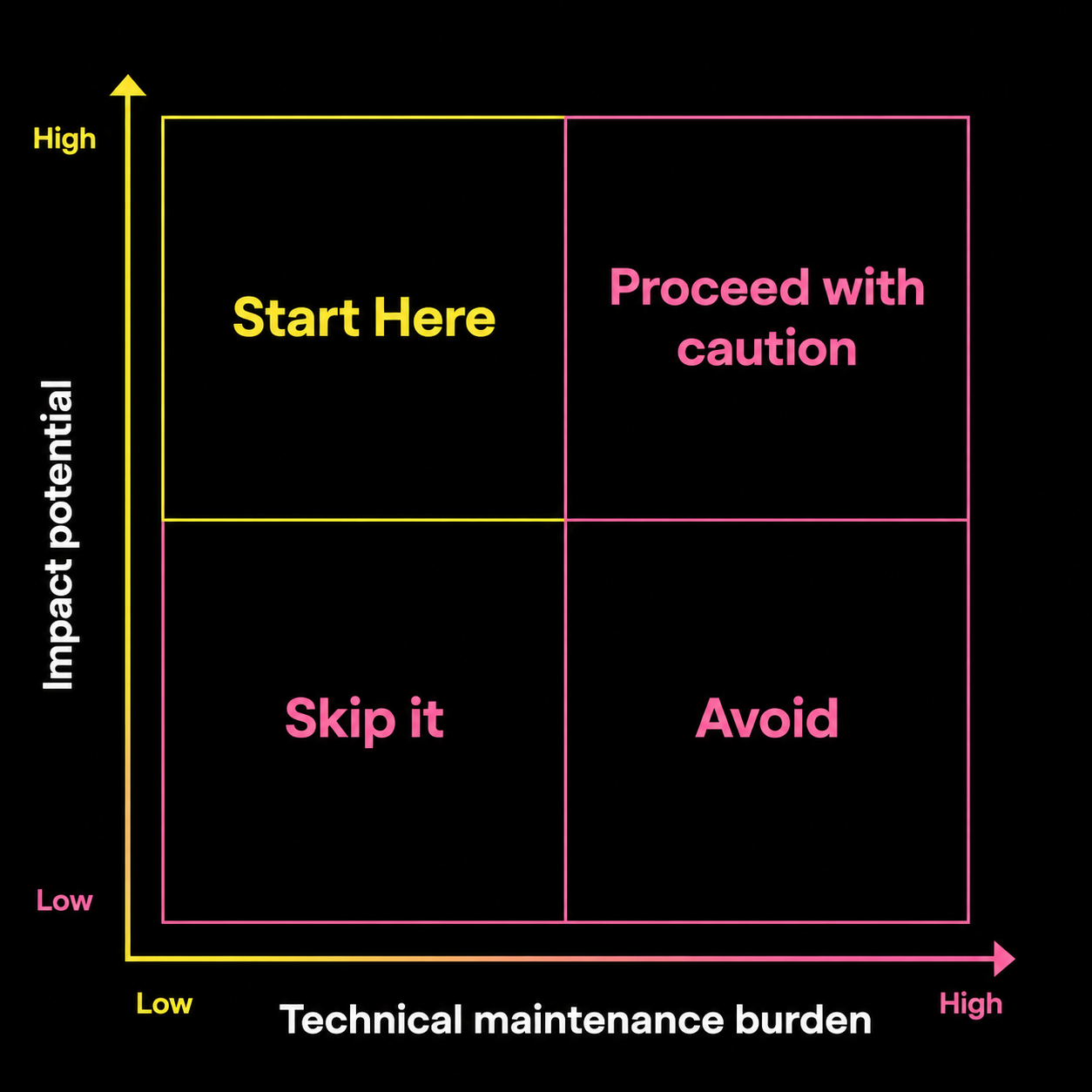
I'm going to be equally specific here, because the failure modes are where organizations lose time, money, and staff trust.
Systems That Require Technical Maintenance
This is the single most common failure pattern I see. An organization gets excited about an AI tool, someone tech-savvy on staff champions it, they implement it, and it works. Then that person leaves, or moves to a different role, and within six months the system is either broken or abandoned.
The research confirms this pattern. Sixty-five percent of nonprofits characterize their AI use as reactive and individual, meaning one-off prompts and personal experimentation, with just 18% reporting operational use across team workflows.[4] Only 4% say they have documented, repeatable workflows.[5] That last number matters. If a workflow isn't documented and teachable to someone new, it's not a system. It's a person-dependent habit, and person-dependent habits don't survive turnover.
Before you implement any AI tool, ask this: can a competent but non-technical staff member operate this after a two-hour onboarding? If the answer is no, the tool is going to cost you more in training and re-training over time than it saves.
Tools Dependent on Consistent Staffing
Closely related to the above. Agentic AI systems, the kind that take action on your behalf over time, need someone to oversee them, monitor their outputs, correct their errors, and make judgment calls at the edge cases. If your organization doesn't have a dedicated person with bandwidth to do that, agentic tools will drift. They'll send emails you didn't mean to send, generate reports nobody checked, or take actions that were technically within their parameters but wrong for your situation.
I've watched organizations implement AI-powered donor outreach tools that worked well for the first three months and then started producing communications that felt slightly off because nobody was reviewing the outputs. The staff who set up the system had moved on. The people running it didn't know what "good" looked like, so they couldn't tell when the tool drifted.
Platforms Requiring Significant Data Infrastructure
AI tools that promise sophisticated analytics, predictive modeling, or machine learning-driven insights sound compelling in vendor demos. The problem is that most mission-driven organizations don't have the underlying data infrastructure to support them.
Clean, consistent, longitudinal beneficiary data is rare. Program records are often siloed across grant cycles. Volunteer records may be in spreadsheets. Donor data may live in a CRM that was last updated properly in 2019. AI tools that need well-structured data to function are tools that require you to solve your data problem before you can use them. That is a real project, with real cost and real time, and most organizations aren't budgeting for it.
The NetHope research on humanitarian AI implementations is candid about this: transitioning from pilot to scale consistently fails when organizations underestimate the ongoing resources required, including technical experts, funding for tools and services, and internal processes.[6]
The Questions Mission-Driven Leaders Need to Ask
I've been doing technology implementation for three decades. I'm a medical technologist by background, which means I spent years working in environments where the wrong result could harm a patient. That training gave me a particular approach to evaluating any new system: it has to work reliably, under real conditions, operated by real people, not under optimal conditions by the vendor's demo team.
Here are the questions I ask before any AI implementation in a mission-driven context.
What happens when the person who runs this leaves? If the honest answer is "we'd have to start over," you need to either choose a simpler tool or invest in documentation and cross-training before you launch.
Can we actually see what this tool is deciding, and why? AI systems that produce outputs without explainable logic are not appropriate for decisions with real human consequences. Your case managers need to be able to understand, audit, and override AI recommendations. If the vendor can't show you how the system explains its outputs, that's a signal.
Where is our data going, and who can see it? Seventy percent of nonprofit professionals are concerned about data privacy and security, and they should be.[5] Beneficiary data, donor records, and program information are sensitive. Before you hand that data to any AI tool, you need to know: what's the vendor's data retention policy, is your data used to train their models, and what happens if they have a breach?
Does this require a stable tech environment we don't have? If the tool depends on clean CRM data, consistent staff operation, or integration with other systems that are themselves unreliable, those dependencies are risks. Acknowledge them before you commit.
What does "working" actually look like at six months, not just at launch? Vendors are excellent at showing you launch-day results. Ask them for case studies at the twelve-month mark, when the implementation team has moved on and the day-to-day staff have taken over. That's when you find out whether the tool actually fit the organization.
The Funding Reality (And How to Work Around It)
I want to address this directly because it's the barrier I hear most often from executive directors: "This all sounds interesting, but we can't get funding for it."
That's largely true, and it's a sector-wide failure. Three-quarters of nonprofits believe funders have little to no understanding of their AI-related needs, and fewer than 20% have ever discussed AI with funders.[2] The Bridgespan Group has documented that the nonprofit funding model systematically treats technology as a luxury rather than a strategic investment, which means you're often trying to fund AI infrastructure out of unrestricted dollars that are already spoken for.[2]
But there are paths forward that don't require finding a magic unrestricted grant.
First, start with tools that are already in your budget. Many organizations already pay for Microsoft 365 or Google Workspace, both of which now include significant AI capabilities. You're paying for these features. Using them doesn't require a new line item. Nearly 25% of nonprofits using AI for grant writing are using tools that either came bundled with existing software or cost under $100 a month.[3]
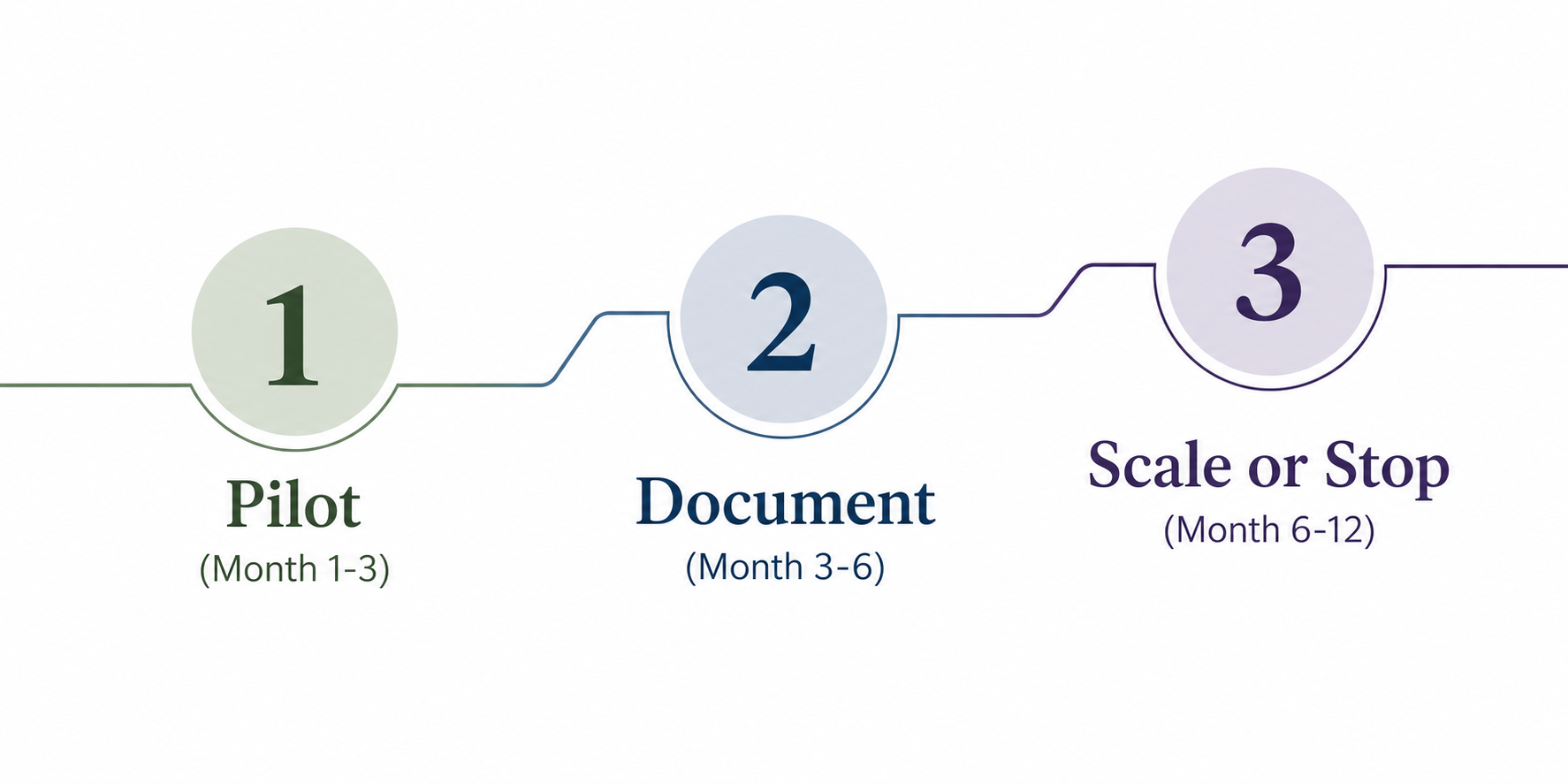
Second, pilot small and document obsessively. Fast Forward's research found that organizations that start with an existing program and prove value internally before scaling are far more likely to succeed, and far better positioned to make the case to funders when they come back asking for implementation support.[7]
Third, build the case with numbers. Funders respond to outcomes, not to technology enthusiasm. If you can show that AI-assisted donor outreach increased your conversion rate by 20%, or that AI document processing freed up 15 staff hours per week that went directly to program delivery, you have an outcome story, not a technology story.
The Ethical Frame That Mission-Driven Leaders Already Have
Here's something I genuinely believe: mission-driven leaders are better positioned to implement AI responsibly than most corporate operators.
You already think about the impact on real people. You already have governance structures, board oversight, and program accountability. You already ask "who does this hurt?" as a first question, not an afterthought. The Fast Forward report found that 70% of nonprofits building AI solutions as part of their mission work regularly incorporate community feedback into system updates, and 61% customize models with their own data.[7] That's a higher rate of responsible practice than most commercial AI deployments.
What you often don't have is confidence. The tools feel unfamiliar. The vendor language is opaque. The risk of getting it wrong feels large when every dollar and every decision is tied to people who are depending on you.
My recommendation is this: start with the use case where you have the least to lose and the clearest way to measure what happened. For most organizations, that's internal document management, grant writing assistance, or donor communication drafting. Tools you can turn off, outputs you review before they go anywhere, results you can actually count.
Don't let the hype convince you to skip the pilot. Don't let the fear convince you to skip the conversation. AI is a real tool with real utility for mission-driven organizations. It's also a real risk if you implement it the wrong way, with the wrong tool, in the wrong context.
I've spent thirty years building systems for organizations where getting it wrong has consequences. The discipline that requires, and the respect for failure modes it demands, is exactly what the AI moment is calling for.
Sources
[1] VolunteerMatters, "Volunteer Retention Strategies That Work in 2025," https://www.volunteermatters.com/blog/volunteer-retention-strategies, 2025
[2] Bridgespan Group, "Closing the Nonprofit Funding Gap in the Age of AI," https://www.bridgespan.org/insights/closing-the-nonprofit-funding-gap-in-the-age-of-ai, 2025
[3] TechSoup and Tapp Network, "Benchmark Report: The State of AI in Nonprofits 2025," https://page.techsoup.org/ai-benchmark-report-2025, 2025
[4] Virtuous Software, "The 2026 Nonprofit AI Adoption Report," https://virtuous.org/resource/the-2026-nonprofit-ai-adoption-report-download/, 2026
[5] NonProfit PRO, "Nonprofit AI Adoption Hits 92% But Only 7% See Major Impact," https://www.nonprofitpro.com/article/nonprofit-ai-adoption-hits-92-but-only-7-see-major-impact/, 2026
[6] NetHope, "Harnessing AI for Humanitarian Impact: Lessons and Insights from 11 Case Studies," https://nethope.org/toolkits/harnessing-ai-for-humanitarian-impact-lessons-and-insights-from-11-case-studies/, 2025
[7] Fast Forward, "2025 AI for Humanity Report," https://www.ffwd.org/2025-ai-for-humanity-report, 2025
[8] Nonprofit Tech for Good, "2026 Artificial Intelligence Marketing and Fundraising Statistics for Nonprofits," https://www.nptechforgood.com/101-best-practices/ai-marketing-fundraising-statistics-for-nonprofits/, 2026
[9] NetHope, "AI Suitability Toolkit for Nonprofits," https://nethope.org/toolkits/the-artificial-intelligence-ai-suitability-toolkit-for-nonprofits/, 2025
[10] Social Current, "The Growing AI Gap Between Social Sector Organizations," https://www.social-current.org/2026/01/the-growing-ai-gap-between-social-sector-organizations/, 2026
[11] BCG, cited in NonProfit PRO, "68% of organizations face critical compliance risks when staff use unauthorized AI tools," https://www.nonprofitpro.com/article/nonprofit-ai-adoption-hits-92-but-only-7-see-major-impact/, 2025