How to Tell If Your Business Is Ready for AI Agents (10-Question Self-Assessment)
Here's the scenario I see over and over. A business owner attends a conference, gets fired up about AI agents, writes a check to a vendor, and six months later they're sitting across from me wondering why nothing is working. The technology is fine. The vendor delivered what they promised. But the business wasn't ready, and now they've spent $80,000 learning that lesson the hard way.
I founded adoption.com in 1995, before Google was a thing. I've run operations across seven countries, including orphanages in Ethiopia, Kenya, and Haiti where you don't get the luxury of a failed pilot. I come from medical technology, where clinical-grade precision isn't optional. So when I say that 80% of AI projects fail to deliver their intended business value, I'm not citing that statistic to scare you [1]. I'm citing it because I've watched the pattern repeat, and I know what separates the businesses that land in the 20% from the ones that don't.
The answer almost always comes down to readiness, not to the AI itself.
This article walks through the 10 factors that actually predict AI agent success. For each one, I'll tell you what it measures, what your answer really means in practice, and what to do if you score low. At the end, I'll give you a scoring guide so you know exactly where you stand and what to do next.
Take the companion quiz first if you want a quick score. Then come back here for the full picture.

Why Most AI Assessments Miss the Point
The problem with most "AI readiness" frameworks is that they're written by people who want to sell you AI services. They're designed to make you feel ready enough to buy, not honest enough to evaluate.
I'm not going to do that. I've seen what happens when businesses rush into AI agent deployments without the foundation in place. Gartner predicts that through 2026, organizations will abandon 60% of AI projects that aren't supported by AI-ready data [2]. The S&P Global Market Intelligence survey found that 42% of companies abandoned most of their AI initiatives in 2025, up sharply from 17% just a year earlier [3]. That acceleration isn't because AI got worse. It's because the gap between pilot enthusiasm and production reality finally caught up with people.
What follows is the honest version of this assessment. Score yourself truthfully.
The 10-Question Self-Assessment
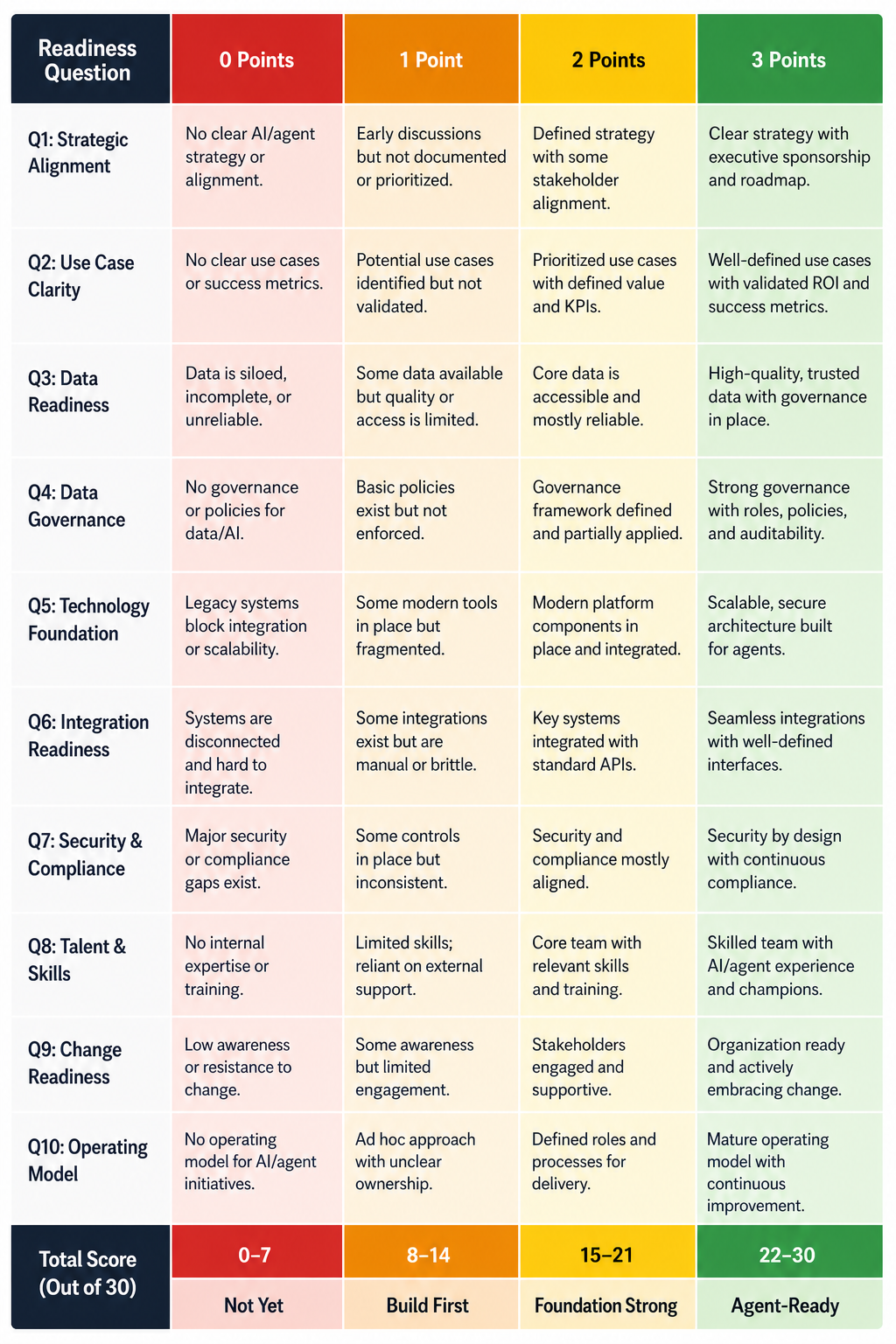
Question 1: Do You Have a Specific, Measurable Problem AI Will Solve?
What it measures: Strategic clarity. Whether AI is the answer to an actual business question, or a solution looking for a problem.
I can't tell you how many discovery calls I've taken where the business owner tells me they want to "use AI agents to improve efficiency." That's not a problem. That's a vague aspiration, and vague aspirations produce failed projects.
Before any AI agent can help you, you need to be able to finish this sentence: "Right now, it takes us [X hours / costs us $Y / causes Z errors per month] to do [specific task]. If we could reduce that by [percentage], it would mean [concrete dollar or time value] to the business."
If you can't fill in those blanks, you're not ready for AI agents. You're ready for a strategy session.
Score 3 if you have a documented problem with quantified current cost and projected value.
Score 2 if you have a clear process in mind but haven't quantified the impact yet.
Score 1 if you're thinking about a general area (like "customer service" or "marketing") without a specific workflow identified.
Score 0 if your answer is some version of "stay competitive" or "not fall behind."
If you score low: Spend two weeks documenting your top three operational pain points. Time them. Cost them out. The AI question comes after you know which problem is worth solving.
Question 2: How Clean and Accessible Is Your Data?
What it measures: Data foundation. AI agents can only be as reliable as the data they operate on.
This is the question that ends more AI projects than any other. Gartner's Q3 2024 survey of 248 data management leaders found that 63% of organizations either don't have or aren't sure if they have the right data management practices for AI [2]. An Informatica survey found that only 12% of organizations report data of sufficient quality and accessibility for AI applications [4].
Read that again: only 12%.
When I was a medical technologist, we had a phrase: garbage in, garbage out. That's even more dangerous with AI agents, because AI doesn't just give you one wrong answer, it scales a wrong answer across every decision it makes. If your customer data has duplicates, your inventory records are split between three systems that don't talk to each other, or your team is still managing pipelines through emailed spreadsheets, an AI agent won't fix that. It'll amplify it.
Score 3 if your data is centralized, consistently formatted, governed, and regularly audited for quality.
Score 2 if your data is mostly in one place but has known quality gaps you're actively working on.
Score 1 if your data is scattered across multiple systems with inconsistent formats.
Score 0 if your team regularly debates which system has the "real" numbers.
If you score low: Don't try to implement an AI agent until you've done a data audit. Map where your data lives, identify the gaps, and create a governance policy. This work takes time, but Gartner found that organizations with successful AI initiatives invest up to four times more in data quality and governance than those that fail [5]. That's not a coincidence.
Question 3: Do Your Core Business Processes Have Clear, Documented Steps?

What it measures: Process maturity. AI agents execute processes. If your processes are undefined, inconsistent, or tribal knowledge, the agent has nothing to execute.
Here's something I've learned from running operations across multiple countries and cultures: if you can't explain a process clearly enough for a new hire in a different country to follow it, you can't explain it clearly enough for an AI agent either.
AI agents are essentially very sophisticated instruction-followers. They can make judgment calls within defined parameters, but they need those parameters defined. McKinsey found that organizations reporting significant financial returns from AI are twice as likely to have redesigned their end-to-end workflows before selecting modeling techniques [6]. The workflow comes first. The AI comes second.
This doesn't mean your processes need to be perfect before you start. But they do need to be documented, tested, and owned by someone.
Score 3 if your target processes are fully documented with clear decision trees, edge cases identified, and a named owner.
Score 2 if the process is documented at a high level but the edge cases and exceptions aren't captured.
Score 1 if the process lives primarily in one person's head, or varies significantly based on who's doing it.
Score 0 if your honest answer is "we figure it out as we go."
If you score low: Pick one process and spend a week shadowing the person who does it best. Document every step, every decision point, every exception. That documentation is your AI agent's instruction manual.
Question 4: Do You Have the Technical Infrastructure to Support AI Agents?
What it measures: Integration readiness. Whether your systems can actually connect to and work with AI tools.
You don't need to be a tech company to be ready for AI agents. But you do need to have systems that can talk to each other. An AI agent that can't connect to your CRM, can't read your calendar, can't write to your project management tool, is an AI agent that can't do its job.
The three things I look for in a technical readiness check are: first, whether your core systems have APIs or integrations available; second, whether you have someone (internal or external) who can manage those integrations; and third, whether your infrastructure can handle increased data processing loads without falling over.
Score 3 if you're already using connected software systems with APIs, have IT support or a technical resource, and your systems have room to grow.
Score 2 if your core systems have integration capabilities but you haven't used them much, and you'd need external help.
Score 1 if your tech stack is primarily disconnected tools, spreadsheets, and manual data transfers.
Score 0 if your answer to "what systems do you use" is a list of software names with no idea how they connect.
If you score low: Before investing in AI agents, invest in your integration foundation. This might mean migrating to a modern CRM, standardizing on a project management platform, or simply getting a technical audit of what you have. Building AI on top of disconnected legacy systems doesn't work.
Question 5: Do You Have Clear AI Governance and an Acceptable Risk Tolerance?
What it measures: Governance maturity. Whether you have the guardrails in place to deploy AI responsibly.
This question makes some business owners roll their eyes. Governance sounds like corporate bureaucracy. But here's what governance actually means in practice: who approves what the AI agent can do, who reviews its outputs, who gets called when something goes wrong, and how quickly can you turn it off.
Only 26% of organizations have comprehensive AI security governance policies in place [7]. The IBM Cost of a Data Breach Report found that 63% of organizations experiencing a breach did not have a formal AI governance policy [8]. And critically: 83% of organizations plan to deploy agentic AI into their business functions, but only 31% feel fully equipped to secure those systems [7].
Agentic AI, specifically, carries risks that standard software doesn't. An AI agent can take actions: it can send emails, modify records, make purchases, interact with customers. If it goes wrong without guardrails, it doesn't make one mistake. It makes thousands of identical mistakes in the time it takes you to notice.
Score 3 if you have documented policies on AI use, data handling, human oversight requirements, and incident response.
Score 2 if you've thought through the risks and have informal policies, but nothing documented or tested.
Score 1 if your approach is "we'll figure out the guardrails after we see how it works."
Score 0 if the concept of AI governance hasn't come up in your planning at all.
If you score low: Governance doesn't need to be a 50-page document. Start with three questions: What can the AI agent do without human approval? What requires a human to review before action is taken? Who gets notified if something goes wrong? Write down your answers. That's the beginning of governance.
Question 6: Does Your Team Have the Skills and Willingness to Work Alongside AI?
What it measures: Workforce readiness. Whether your people will use, maintain, and supervise AI systems effectively.
Nearly half of CEOs report that most of their employees are resistant or even openly hostile to AI-driven changes [9]. At the same time, only 12% of workers received any AI training in 2024, despite 75% already using AI tools at work [9]. There's a massive gap between AI arriving in the workplace and people actually knowing how to work with it.
Here's the honest reality I've watched play out: technology adoption is a people problem 84% of the time [3]. The root causes of AI project failure trace back to leadership decisions and cultural readiness far more often than to technical limitations.
I've managed operations in Ethiopia, Kenya, and Haiti, places where the usual Western assumptions about technology adoption don't apply. What I learned is that tools don't drive adoption. Trust, training, and visible quick wins do. Before you deploy an AI agent, you need to know whether your team sees AI as a threat or as a tool they want to master. And if they see it as a threat, that's not their problem. That's your communication and change management problem.
Score 3 if your team is actively curious about AI, you have identified champions, and you have a training plan.
Score 2 if there's general openness but no formal training or AI champions in place.
Score 1 if there's significant skepticism or anxiety, and no change management plan.
Score 0 if AI is a topic you're avoiding with your team because you know it'll be contentious.
If you score low: Don't deploy AI to a resistant team. You'll get surface-level compliance and covert workarounds, and the AI agent's metrics will look terrible because people will route around it. Invest in training first. BCG research shows that training significantly reduces employee concerns about AI [9]. The ROI on change management before deployment is dramatically better than damage control after.
Question 7: Is There a Named Human Owner for Each AI Agent Deployment?
What it measures: Accountability structure. Whether someone is responsible for the AI's performance, not just its launch.
This is a detail that almost every AI deployment I've reviewed misses. Organizations get excited about the launch. They pick the tool, build the integration, do the testing, flip the switch. And then they move on to the next project. Nobody is assigned to monitor whether the AI agent is still performing correctly six weeks later, whether the data it's using has drifted, or whether the business conditions it was built for have changed.
AI agents are not set-and-forget. They need owners. Specifically: someone who checks the outputs regularly, someone who gets notified when the agent encounters an error it can't handle, and someone with the authority and skill to adjust the agent's parameters when the business changes.
Score 3 if every planned AI deployment has a named owner who has agreed to the responsibility, has time allocated for it, and knows how to monitor performance.
Score 2 if there's a general understanding of who "would" own it, but no formal accountability or time allocation.
Score 1 if ownership is assumed to fall to whoever deployed it as an add-on to their existing job.
Score 0 if AI agent ownership has never come up in your planning conversations.
If you score low: Before you deploy anything, write an ownership charter for it. One page. Named owner, what they're responsible for monitoring, how often they review it, what escalation looks like. AI agents without owners become AI agents nobody trusts.
Question 8: Have You Identified a Pilot Use Case That's Low-Risk and High-Feedback?
What it measures: Deployment strategy. Whether you're starting where it's smart to start, rather than where the ambition is highest.
One of the most common mistakes I see is businesses wanting to start with the biggest, most complex, most transformational AI agent possible. They want to automate their entire sales pipeline, or reimagine their customer service operation from the ground up. And they want to do it first.
That's the wrong order. The organizations in the 20% that actually get ROI from AI almost always started somewhere small, low-risk, and highly measurable. A use case where if the AI gets it wrong, a human catches it before it causes damage. A use case where you can see clear before-and-after data within four to six weeks. A use case that is boring enough that failure doesn't make the news, but important enough that success proves the concept.
Think: internal document summarization before external customer communications. Think: draft generation with mandatory human review before autonomous sending. Think: data extraction from a format you already verify manually.
Score 3 if you have a specific pilot use case identified that is low-stakes, high-feedback, and has a named person responsible for reviewing outputs.
Score 2 if you have a general use case area in mind but haven't scoped the pilot specifically.
Score 1 if your planned first deployment is complex or high-stakes.
Score 0 if you're planning to deploy broadly across the organization in your first rollout.
If you score low: Find your "boring win." The unglamorous, repetitive task that takes real time and has clear quality standards. That's where AI agents build trust, in your team and in your systems. The transformational use cases come after you've earned that trust.
Question 9: Do You Have a Way to Measure Whether the AI Is Actually Working?
What it measures: Measurement capability. Whether you have the metrics infrastructure to know if an AI agent is succeeding or failing.
Only 29% of executives say they can measure AI ROI confidently, despite 79% reporting productivity gains [10]. That gap is telling. People can feel that something is faster or easier. But if you can't measure it, you can't improve it, you can't justify continued investment, and you can't catch a slow degradation in performance before it costs you.
For AI agents specifically, measurement needs to operate at two levels. First, process metrics: Is the agent completing tasks? How fast? With what error rate? How often does it escalate to a human? Second, business impact metrics: Are the outcomes we built this for actually happening? If you deployed an AI agent to improve customer response time, is customer satisfaction going up? If you deployed it to reduce manual data entry errors, is your error rate actually lower?
Both levels matter. Process metrics tell you if the agent is running correctly. Business metrics tell you if you deployed it to the right problem.
Score 3 if you have baseline measurements for the target process now, and a defined measurement plan for post-deployment.
Score 2 if you know what you'd measure but don't have current baselines to compare against.
Score 1 if measurement will be an afterthought once the agent is deployed.
Score 0 if success will be evaluated by gut feel.
If you score low: Set your measurement baseline before you deploy anything. Time the current process. Count the current error rate. Survey current satisfaction. Without that baseline, you'll spend your first AI project arguing about whether it worked instead of proving it did.
Question 10: Does Your Leadership Team Understand What AI Agents Can and Can't Do?
What it measures: Expectation alignment. Whether leadership's mental model of AI matches reality closely enough to make good decisions.
This is the one I usually save for last, because it's the most sensitive. But it's also the one that determines whether all the other readiness factors actually get used or ignored.
Leadership expectations drive resource allocation, timeline pressure, and what counts as success. If your CEO believes AI agents are magic and expects transformation in 90 days, every difficult reality your team surfaces will be treated as an implementation problem rather than a planning problem. If your CFO thinks AI is hype and won't allocate resources to do it right, the team will cut corners that lead to exactly the failures the CFO was already predicting.
The businesses that succeed with AI agents have leadership teams with a grounded, accurate mental model. They understand that AI agents can automate repetitive, rule-based tasks within defined parameters. They understand that AI agents still need human oversight, at least in the beginning. They understand that AI agents require ongoing maintenance, not just installation. And they understand that the ROI timeline is typically measured in quarters, not weeks.
Score 3 if your leadership team has received a formal AI education (workshop, consultation, or structured reading) and can articulate specific capabilities and limitations.
Score 2 if leadership is generally AI-literate from self-directed learning, and conversations are grounded rather than hype-driven.
Score 1 if leadership's understanding of AI comes primarily from vendor marketing or media coverage.
Score 0 if AI expectations have never been formally aligned among your leadership team.
If you score low: Before anything else, invest in a structured leadership education session. Not a vendor demo. A neutral, honest session about what AI agents actually do, what they don't do, and what realistic timelines look like. I offer exactly this as a starting point for every client engagement, because nothing else works until leadership's mental model is accurate.
Your Score: What It Means and What to Do Next
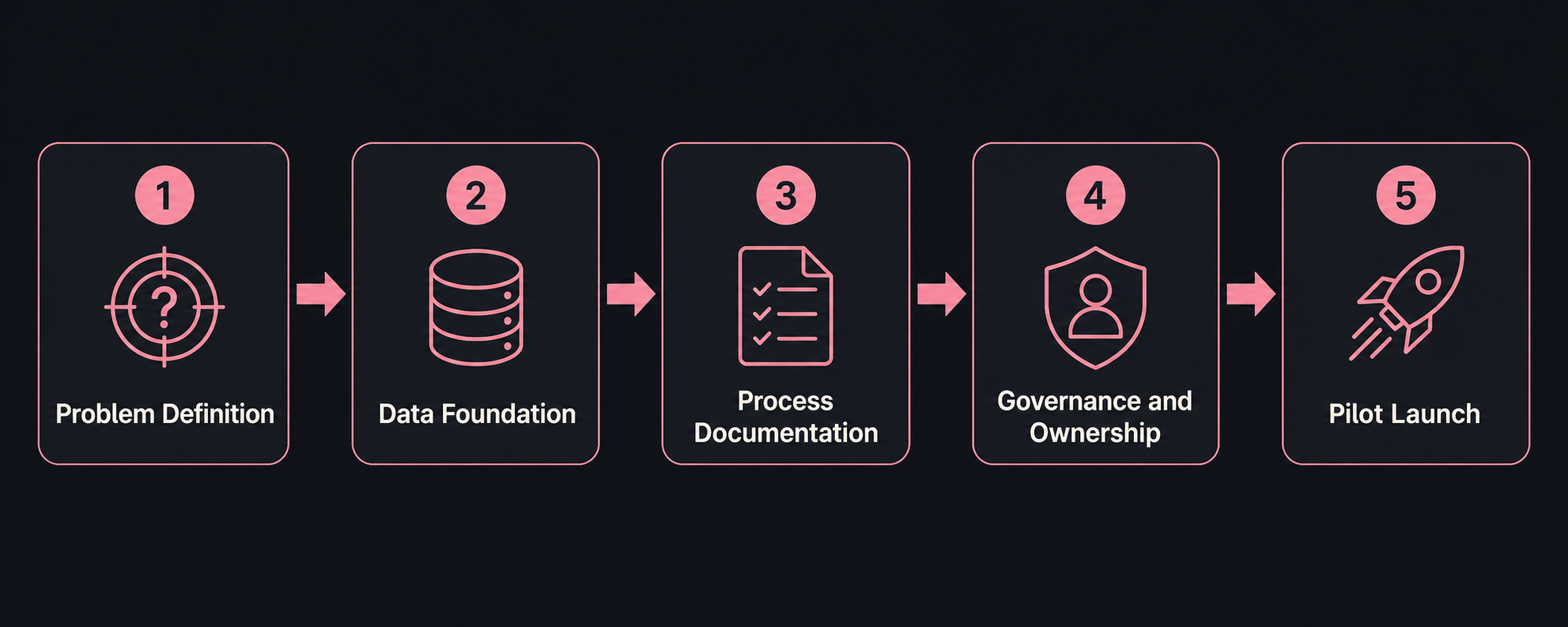
Add up your points. Maximum possible score is 30.
25 to 30: Agent-Ready
You've done the work. Your data is solid, your processes are documented, your team is engaged, and your leadership has accurate expectations. You're in an excellent position to start your first AI agent deployment and you're likely to land in the 20% that actually gets measurable ROI.
What to do: Move to selection. Pick your pilot use case, evaluate tools against your specific process requirements, and launch with a defined measurement plan. Consider bringing in a consulting partner to accelerate time-to-value and avoid common integration pitfalls.
18 to 24: Foundation Strong, Gaps Exist
You have real strengths here, but you've also got two or three areas where you're underinvested. You can move forward, but you should be deliberate about it. Don't try to build everything at once.
What to do: Identify your lowest two or three scores and rank them by the effort required to improve versus the risk of not improving. Data and governance issues should be fixed before deployment. Team readiness can sometimes be built in parallel. Pick your lowest-risk, highest-feedback pilot use case and use it as a forcing function to close your gaps while building real experience.
10 to 17: Build Before You Buy
You've got enthusiasm, but the foundation isn't there yet. Deploying AI agents now is likely to produce the expensive failure story I described at the opening. This isn't a technology problem, it's a readiness problem, and the fix is in the fundamentals, not in finding a better vendor.
What to do: Focus on your two lowest-scoring areas for the next 90 days. Data quality and process documentation are the highest-leverage investments at this stage. If your team readiness score is low, start with internal AI awareness training before any deployment. Come back and re-score yourself in 90 days. The gap is closeable.
Below 10: Not Yet
I know that's not what you wanted to hear. But the honest truth is that deploying AI agents right now would most likely add cost and complexity without adding value. Gartner found that 60% of AI projects unsupported by AI-ready data get abandoned [2]. You'd be spending money to join that statistic.
What to do: Start with a structured AI readiness consultation. Not a tool purchase. Not a pilot. A real assessment of where your gaps are and a prioritized roadmap for closing them. The businesses that eventually become AI-powered didn't skip this step. They just did it before, rather than after, they spent the budget.
One More Thing I Want to Say Directly
The AI industry has a vested interest in convincing you that you're ready right now. Vendors want to close deals. Consultants who get paid per implementation want you to implement. Conference speakers want to inspire action.
I want you to implement AI agents successfully. And "successfully" means: measurable ROI, not just a rollout. A foundation that scales, not a one-time integration that breaks when someone leaves. A team that actually uses the tools, not a system that gets quietly routed around.
I'll be honest about where I'm coming from. I'm new to AI consulting specifically. What I'm not new to is helping organizations navigate a technology paradigm shift. At Cap Gemini in the 1990s, I worked with businesses figuring out internet strategy before most people had an email address. That's the direct parallel: transformative new technology, skeptical organizations, consultants who either helped them build something real or helped them spend money on slides. I've also been hands-on building AI agents and web applications using Claude Code and Codex, so I'm not a strategist who learned to talk about AI. I've built with these tools.
The thing that 30 years of building real systems taught me is that preparation is not a delay. It's the actual work. Score yourself honestly. Build what needs building. Then move.
If you'd like a guided version of this assessment with personalized recommendations for your industry and business size, that's exactly what a Verity Agentic readiness consultation delivers. Get in touch.
Sources
[1] RAND Corporation, "Why More Than 80% of AI Projects Fail to Deliver Business Value," cited in Pertama Partners, https://www.pertamapartners.com/insights/ai-project-failure-statistics-2026, 2024
[2] Gartner, "Lack of AI-Ready Data Puts AI Projects at Risk," https://www.gartner.com/en/newsroom/press-releases/2025-02-26-lack-of-ai-ready-data-puts-ai-projects-at-risk, 2025
[3] S&P Global Market Intelligence / RAND analysis, cited in Softobiz, "AI Project Failure Rate Statistics: What the Data Says in 2026," https://softobiz.com/blogs/ai-project-failure-rate-statistics/, 2025
[4] Informatica, "2025 CDO Insights Survey," cited in SR Analytics, "Why 95% of AI Projects Fail and How Data Fixes It," https://sranalytics.io/blog/why-95-of-ai-projects-fail/, 2025
[5] Gartner, "Organizations with Successful AI Initiatives Invest Up to Four Times More in Data and Analytics Foundations," https://www.gartner.com/en/newsroom/press-releases/2026-04-16-gartner-says-organizations-with-successful-ai-initiatives-invest-up-to-four-times-more-in-data-and-analytics-foundations, 2026
[6] McKinsey and Company, "The State of AI in 2025: Agents, Innovation, and Transformation," https://www.mckinsey.com/capabilities/quantumblack/our-insights/the-state-of-ai, 2025
[7] Cloud Security Alliance, "The State of AI Security and Governance," https://cloudsecurityalliance.org/artifacts/the-state-of-ai-security-and-governance, 2025
[8] IBM, "Cost of a Data Breach Report," cited in Knostic, "The 20 Biggest AI Governance Statistics and Trends of 2025," https://www.knostic.ai/blog/ai-governance-statistics, 2025
[9] AI Smart Ventures, "Why Do AI Implementations Fail Without Change Management?" https://aismartventures.com/posts/why-do-ai-implementations-fail-without-change-management-the-people-side-of-ai-transformation/, 2025
[10] CloudNSite, "AI ROI: Real Automation Payback Numbers," https://cloudnsite.com/blog/ai-automation-roi-real-numbers, 2025