The AI Readiness Assessment That Actually Matters (It's Not About Your Tech Stack)
The pattern shows up repeatedly in AI implementation research: a company spends $800,000 on an AI implementation. Latest infrastructure, solid data lake, a vendor who charged premium rates to install everything correctly. Twelve months later, the system is barely used. Half the team quietly went back to spreadsheets. The other half never really adopted it in the first place.
When researchers ask what went wrong, the answer is almost always the same: "I don't know. The tech worked."
The tech worked. That's almost always the answer I hear when an AI project fails. And it tells me everything I need to know: this company failed its AI readiness assessment before it ever bought a single license.
I've spent thirty years building systems that survive contact with reality. I founded adoption.com in 1995, before Google existed, and ran it for years while managing humanitarian operations across three continents. I've built operations in Ethiopia, Kenya, Haiti, Mexico, England, China, and the United States. When I started Verity Agentic, I wasn't a technologist who learned business. I was a business operator who had spent decades mastering technology because the systems I built couldn't fail: children's lives sometimes depended on them running correctly.
What I learned across all of that is the same thing the data now confirms: AI readiness has almost nothing to do with your tech stack. The frameworks that most consultants sell you, the ones with lengthy checklists about cloud infrastructure and API integrations, are measuring the wrong things.
Here's what actually predicts whether your AI investment will pay off.

Why Most AI Readiness Frameworks Get It Wrong
The AI industry has a dirty secret. Over 80% of AI projects fail to deliver their intended business value, roughly twice the failure rate of comparable IT projects without AI.[1] For generative AI specifically, MIT's Project NANDA found in July 2025 that 95% of organizations deploying generative AI saw zero measurable return on the investment.[2]
You'd think after numbers like that, the industry would stop selling frameworks centered on infrastructure and start asking harder questions. Instead, most readiness assessments I've seen focus on things like network bandwidth, data storage capacity, and whether you have the right cloud provider. Those matter eventually. They're not what fails you.
Gartner's research is instructive here. They found that only 48% of AI pilots ever reach production.[3] And when they asked why, the answer wasn't "our servers were too slow." RAND Corporation's 2024 root-cause analysis found that 84% of AI implementation failures are leadership-driven, not technical.[4]
Leadership. Process. People. Culture. Execution habits. That's what separates the 13% of organizations that Cisco's AI Readiness Index calls "Pacesetters" from everyone else.[5] And Pacesetters aren't just marginally better: they're four times more likely to move AI pilots to production and 90% report gains in profitability and productivity.[5]
So let me walk you through the five pillars I actually use when I'm assessing whether a company is ready to deploy AI. I'll give you the diagnostic questions for each one. And I'll be honest about what answers tell me to pump the brakes.
Pillar 1: Process Documentation
Can AI Run Your Process Without Constant Hand-Holding?
Here's the fundamental thing most people miss about AI: it can only automate what you've already defined. If your process exists primarily inside someone's head, or if it changes based on which employee is on shift that day, AI can't reliably run it. Not yet. Not without costing you more in prompt engineering and edge-case management than you'd have spent just hiring another person.
I come from a medical technology background, where documentation isn't optional. Clinical processes have to be written down precisely, because lives depend on them being followed exactly, whether the experienced nurse is there or not. That clinical-grade precision is what every business process needs before AI can touch it.
The brutal diagnostic question is this: if your most experienced person quit tomorrow, could a capable new hire follow your written documentation and achieve the same outcomes within 30 days? If the answer is no, you're not ready for AI in that process.
Questions to ask yourself:
- Do we have written standard operating procedures for the processes we want to automate?
- When we follow those SOPs, do we get consistent outcomes? Or do "it depends" answers come up constantly?
- If I handed our documented process to someone who had never worked here, could they run it without calling our team for help?
- Have we mapped the decision points in this process, including the edge cases and exceptions?
I often find that attempting AI implementation is actually the best process documentation audit a company can run. The moment you try to describe your process to an AI system, every gap in your documentation becomes painfully obvious. The question is whether you discover this before or after you've spent the budget.
Organizations that have clear, consistent, documented processes see AI deliver value 3x faster than those trying to automate poorly defined workflows.[6] That's not a technology statistic. That's an operations discipline statistic.
Pillar 2: Data Accessibility and Quality

Does the AI Have What It Needs to Learn From?
People always want to talk about data volume. "We've got terabytes." Great. That's like telling me you have a lot of ingredients without mentioning that half of them are expired, they're scattered across fourteen different cupboards, and some of them are labeled in a language nobody on the team can read.
Informatica's 2025 CDO Insights survey found that data quality and readiness is the top obstacle to AI success at 43% of organizations.[7] And Gartner has predicted that 60% of AI projects lacking AI-ready data will be abandoned through 2026.[3] Not fail quietly. Abandoned. Cut off. Money written off.
The access problem is just as common as the quality problem. I've worked with companies that have genuinely good data, carefully maintained, historically consistent. But it's siloed across six different systems that don't talk to each other, controlled by three different departments who don't share willingly, and extracting it requires a manual process that takes three days. AI can't access data that lives behind organizational politics and technical walls.
Only 19% of organizations have fully centralized data infrastructure ready for AI according to Cisco's 2025 index.[5] That number should stop you cold. It means four out of five companies are trying to build AI on a foundation that doesn't exist yet.
Questions to ask yourself:
- Where does the data this AI system needs actually live, and who controls access to it?
- When was this data last audited for accuracy? Do we know the error rate?
- Is data entered consistently, or does it depend on individual employees following (or not following) guidelines?
- Can we access historical data to train or validate the system, or do we only have recent records?
- Are there data privacy or regulatory constraints that affect what AI can see or use?
- If I asked our data team to pull a clean, complete dataset for this use case today, how long would it take?
I'm not saying your data has to be perfect. Perfection is a fantasy. But you need to know what you have, where it lives, and what its limitations are before you build an AI system that depends on it. The systems I've built in humanitarian operations had incomplete data constantly. I worked around it by knowing exactly where the gaps were and designing accordingly. You can do the same in business. But you have to look first.
Pillar 3: Change Management Capacity
How Does Your Team Actually Handle New Systems?
This is the pillar that makes the most hardworking, well-intentioned technology teams flinch, because it's not really a technology question. It's a people question. And people questions are messier.
Here's the pattern I've seen play out dozens of times. A company deploys a new AI system. The tech team is proud of it. The vendor does a training session. A few early adopters embrace it immediately. Everyone else finds quiet workarounds to avoid using it while appearing cooperative in meetings. Within six months, adoption is at 30%, leadership is frustrated, and the tech team is being blamed for something that was never a technology problem.
McKinsey's 2025 State of AI research found that AI high performers are 2.8 times more likely to report fundamental workflow redesign than their peers.[8] This is counterintuitive. You'd expect the relationship to run the other way: companies deploy AI, then redesign workflows. What McKinsey is actually finding is that companies willing to fundamentally redesign how they work are the ones succeeding with AI, not the ones who try to bolt AI onto existing workflows unchanged.
The abandonment rate for AI projects increased by 147% between 2024 and 2025.[4] Companies didn't run out of money. They ran out of organizational will.
Questions to ask yourself:
- What was the last major system change we implemented? Did adoption hit 80%+ within six months?
- When employees push back on new systems, how does leadership respond? Do they enforce adoption, or do they accommodate resistance?
- Do we have a change management playbook, or do we just announce things and hope?
- Who are the informal influencers on our team, and are they going to champion this or quietly undermine it?
- Have we ever tracked adoption metrics on a technology rollout? What were they?
- Is the team that will use this AI system involved in the design and selection process, or are they being handed a finished tool?
The answer I trust most from executives is when they can tell me a story of a hard system change that went well, because then I know they have experience managing it. The answer that worries me most is when they say, "Our team is adaptable." Everyone says that. Almost nobody has the receipts to prove it.
When I was setting up operations in Haiti, I couldn't afford for systems to fail because people hadn't adopted them. I involved the team in building the process before I handed it to them. That's not a luxury approach. That's what you do when failure isn't an option.
Pillar 4: Leadership Alignment
Is Everyone Actually Pulling the Same Direction?
I want to be careful here, because "leadership alignment" has become a buzzword that sounds obvious and gets skipped. So let me tell you what lack of alignment actually looks like in practice.
The CEO thinks AI is going to transform the business and is talking about it at every board meeting. The COO thinks it's an interesting experiment but isn't committing any of her team's time to it. The head of sales is excited about the AI sales assistant. The VP of customer success is worried it'll erode the relationships she's spent years building and is quietly steering her team away from using it. Nobody has had that conversation directly, because nobody wants to have it.
This is not a hypothetical. It's a composite drawn from patterns documented across published AI implementation research and industry case studies.
Accenture's research found that 83% of "reinvention-ready" firms, the ones achieving the strongest AI outcomes, have CEO-level AI advocacy. But more importantly, they have advocacy that runs all the way through the management chain.[9] Having a CEO who loves AI while a COO quietly drags her feet is almost as bad as having nobody committed.
The specific risk is that misaligned leadership produces mixed signals at every level. Employees watch what their direct managers do, not what the CEO says. If the VP of operations doesn't prioritize the AI implementation in her team's quarterly goals, nobody under her will either.
Questions to ask yourself:
- Have every member of the leadership team specifically stated their commitment to this AI initiative, not just nodded in a meeting?
- Do leaders use the AI tools themselves, or do they delegate that down?
- Are AI outcomes written into leaders' performance goals?
- When there's a conflict between AI-driven recommendations and a leader's gut instinct or personal preference, what wins?
- Is there a clearly named executive owner of this initiative, not just a project manager?
- Have we had the honest conversation about what roles and workflows will change, and does leadership agree on the answer?
I'll tell you the diagnostic I use in my first hour with a new client. I ask each senior leader separately: "In your own words, what problem are we solving with AI, and how will we know in twelve months if it worked?" If I get three different answers with three different success metrics, I know the initiative is in trouble before we've written a single line of code.
High performers in AI, according to McKinsey, are three times more likely to have senior leaders who demonstrate ownership and commitment through their behavior, not just their words.[8] That's a meaningful gap.
Pillar 5: Execution Track Record
Have You Ever Actually Shipped Something Complex and Successful?
This is the pillar nobody puts in their framework, because it's uncomfortable. But in thirty years of building systems in environments where failure wasn't survivable, I've learned that past execution capacity is the single best predictor of future execution capacity.
AI implementation is not uniquely difficult. But it is complex, cross-functional, long-timeline work that requires sustained commitment through inevitable setbacks. It requires the same organizational muscles as any major technology or process transformation.
Here's what I ask: not "are you ready for AI," but "what's the hardest operational thing you've ever pulled off successfully?" Tell me about your last major ERP implementation, or your last merger integration, or the last time you built a new product line from scratch. Tell me how long it took, what went wrong, and how you recovered.
A company that has never shipped anything hard is a company that hasn't yet built the execution muscles that AI demands.
The 10/20/70 model from McKinsey is revealing here: successful AI transformations allocate 10% of their resources to algorithms, 20% to technology and data, and 70% to people and process change.[10] The companies that fail tend to invert that model, loading their investment into technology and leaving almost nothing for the organizational change that determines whether the technology gets used.
Questions to ask yourself:
- What's the most complex cross-functional initiative our organization has completed in the last three years?
- How did we handle it when it hit the inevitable wall? (Every complex project hits a wall. This question reveals whether you have recovery capacity.)
- Do we have a track record of hitting project milestones, or do timelines consistently slip?
- When we've adopted new technology before, has it actually changed behavior, or has it just added a new layer on top of old behavior?
- Have we clearly defined what success looks like for this AI initiative, and does everyone agree on that definition?
- What's the escalation path when the project stalls? Who has authority to make decisions and break logjams?
I'm not looking for a perfect track record. I've never met an organization with one. I'm looking for demonstrated capacity to navigate complexity, make hard decisions under uncertainty, and see things through when they're hard. If the honest answer to most of these questions is "we've never really done anything like this," that doesn't necessarily mean don't do AI. It means understand what you're walking into and resource accordingly.
What the Assessment Actually Tells You
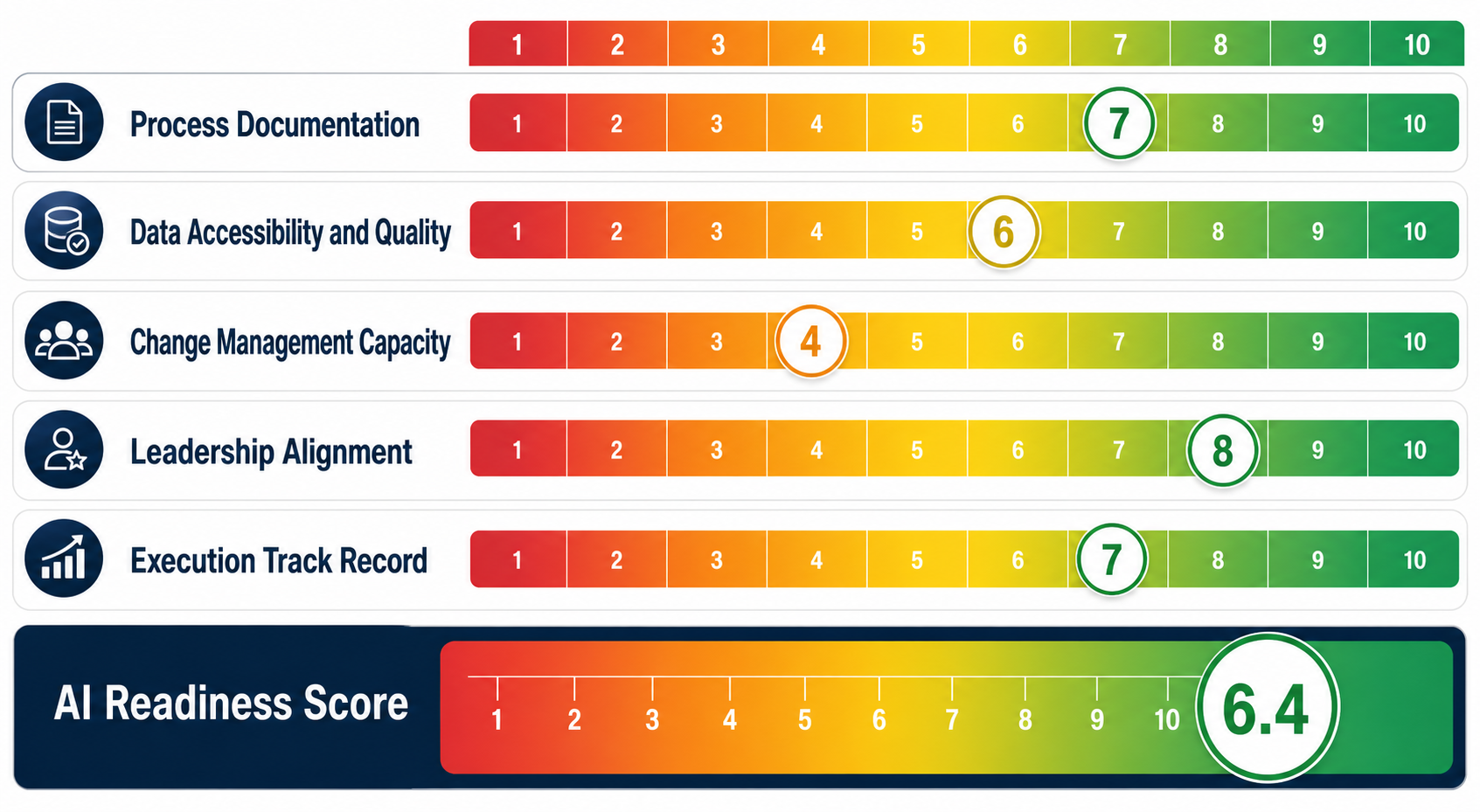
When I run through these five pillars with a client, I'm not looking for perfect scores. I'm looking for an honest picture. Here's how I interpret the results.
If you score well on Process Documentation and Data Quality: You've got the foundation. AI can find traction here. The risk is cultural and political, so focus your energy on pillars 3, 4, and 5.
If you score well on Change Management and Leadership Alignment but weakly on Process and Data: You've got the organizational will, which is genuinely rare and valuable. But you'll burn it on a technical foundation that can't support what you're trying to build. Fix the data and process problems first, or you'll use up your organization's trust on a failed implementation and have nothing left for the second attempt.
If you score weakly on Execution Track Record across the board: I'd recommend starting smaller than you think you should. Pick one process. One team. One clearly defined outcome. Build a win. The organization's ability to execute AI initiatives grows with each success. Starting with a sprawling transformation when you haven't proven you can deliver a small one is how you generate the statistics we talked about earlier.
Organizations that jump into AI without a structured readiness assessment spend an average of 2.3 times more budget and take 40% longer to reach production than those who assess first.[6] That's not a small premium. That's the difference between an AI initiative that generates ROI and one that becomes a cautionary tale in the board room.
The Counter-Intuitive Truth About AI Readiness
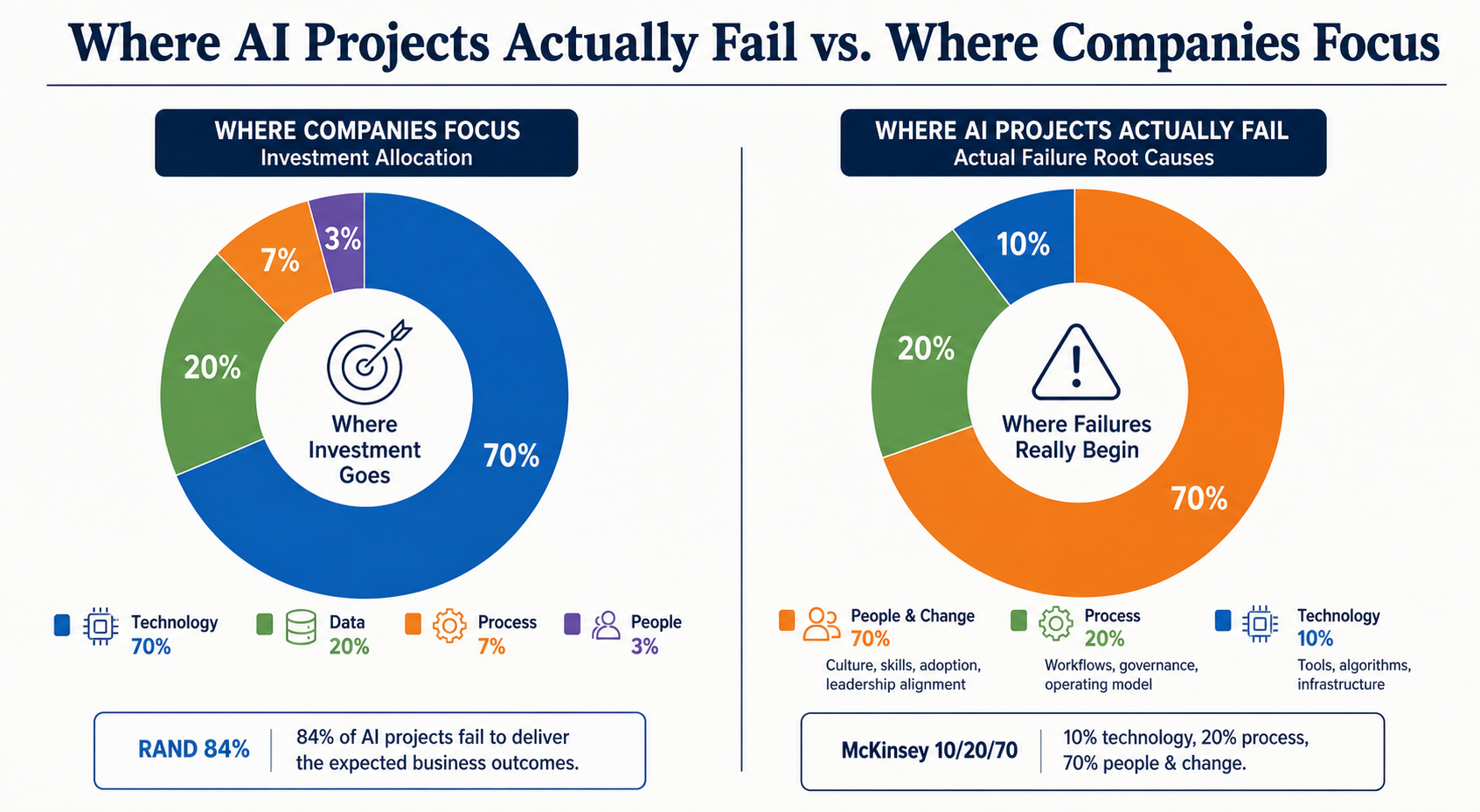
I want to leave you with something that took me a long time to learn, and that I've never seen in a vendor's AI readiness framework.
The companies with the best AI outcomes are often not the most technologically sophisticated. They're the most operationally disciplined. They know their processes. They trust their data. They have leadership that actually leads. They've built cultures where people adopt new tools because those tools genuinely make their work better, and because leadership earns that trust by following through consistently.
When Accenture studied companies with AI-led processes, they found those organizations outperforming peers by 2.5x in revenue growth.[9] The technology was largely the same. The difference was organizational maturity.
The $800,000 AI implementation I mentioned at the beginning didn't fail because the technology was bad. It failed because the company hadn't done the organizational work that makes technology stick. The process wasn't documented. The data was messy. Change management was a training webinar. Leadership said the right words but hadn't redesigned their own workflows. And the company had a history of starting bold initiatives and quietly abandoning them when they got hard.
No tech stack fixes those problems.
If you're honest with yourself through these five pillars and you find real gaps, that's not a reason to give up on AI. It's a roadmap. It tells you exactly what to fix first. And fixing those things will make your organization better regardless of whether you ever deploy a single AI system. Better process documentation, cleaner data, stronger change management, aligned leadership, and a culture of execution: those are competitive advantages that compound.
AI is just the forcing function that makes you build them now.
Work With Verity Agentic
If you'd like to run this assessment with your leadership team, I offer a structured AI Readiness Workshop that walks through all five pillars with your actual processes and data, not a generic framework. The output is an honest scorecard and a prioritized roadmap for what to address first. Reach out at [email protected] to learn more.
Sources
[1] RAND Corporation, "AI Project Failure Rates and Root Causes," cited in Pertama Partners, "AI Project Failure Statistics 2026," https://www.pertamapartners.com/insights/ai-project-failure-statistics-2026, 2026
[2] MIT Project NANDA, cited in SR Analytics, "Why 95% of AI Projects Fail and How Data Fixes It," https://sranalytics.io/blog/why-95-of-ai-projects-fail/, 2025
[3] Gartner, "AI Pilot to Production Statistics and AI-Ready Data Prediction," cited in Astrafy, "Scaling AI from Pilot Purgatory: Why Only 33% Reach Production," https://astrafy.io/the-hub/blog/technical/scaling-ai-from-pilot-purgatory-why-only-33-reach-production-and-how-to-beat-the-odds, 2024
[4] RAND Corporation / Dataconomy, "Why 84% Of AI Projects Fail and It's Not The Technology," https://dataconomy.com/2025/12/10/why-84-percent-of-ai-projects-fail-and-its-not-the-technology/, 2025
[5] Cisco, "AI Readiness Index 2025: Realizing the Value of AI," https://www.cisco.com/c/dam/m/en_us/solutions/ai/readiness-index/2025-m10/documents/cisco-ai-readiness-index-2025-realizing-the-value-of-ai.pdf, 2025
[6] OvalEdge, "What Is AI Readiness? Framework, Assessment & Steps for 2026," https://www.ovaledge.com/blog/what-is-ai-readiness, 2026
[7] Informatica, "CDO Insights 2025: Data Quality as Top AI Obstacle," cited in Agility at Scale, "Data Readiness Assessment for AI," https://agility-at-scale.com/ai/data/data-readiness-assessment-for-ai/, 2025
[8] McKinsey, "The State of AI in 2025: Agents, Innovation, and Transformation," https://www.mckinsey.com/capabilities/quantumblack/our-insights/the-state-of-ai, 2025
[9] Accenture, "New Accenture Research: Companies with AI-Led Processes Outperform Peers by 2.5x in Revenue Growth," https://newsroom.accenture.com/news/2024/new-accenture-research-finds-that-companies-with-ai-led-processes-outperform-peers, 2024
[10] McKinsey, "AI in the Workplace 2025: Superagency and the 10/20/70 Model," https://www.mckinsey.com/capabilities/tech-and-ai/our-insights/superagency-in-the-workplace-empowering-people-to-unlock-ais-full-potential-at-work, 2025